
Reynolds County Criminal Docket Searches
The free public entry point is Missouri Case.net. Got a party name? Use Litigant Name Search. Got a summons or a docket printout with an identifier? Use Case Number/Ticket Number Search instead. The portal adds Filing Date Search and Scheduled Hearings & Trials Search on top of those. When the results load, pick the live 42nd Judicial Circuit/Reynolds County location. Then check that the case carries the CR category. Another criminal category that fits works too. One caution: a statewide name hit proves little. The same name can show up in more than one county.
Case.net is not the only route to Reynolds County court records. When it falls short, the Reynolds County Circuit Clerk is the local hub. Ask court staff to use the public-access terminal. Or call with a case number and case type. Or mail a narrow, focused request. The courthouse sits at 2319 Green Street, Centerville, MO 63633. Mail for the clerk goes to PO Box 39, Centerville, MO 63633. Reported county office hours are 8:00 a.m. to 4:30 p.m. on weekdays. Call (573) 648-2494 ext. 134 first to confirm counter and terminal details.
- Open Case.net and choose the search method that matches the paper or information in hand.
- Limit the location to Reynolds County in the 42nd Judicial Circuit when the current portal offers that choice.
- Open the case-number link and check the Case Header for the court, style, filing date, type, and status.
- Read Docket Entries and Scheduled Hearings & Trials, then open Charges, Judgments & Sentences when that tab is present.
- Use the clerk, terminal, phone, or mail request for an older record, a public document that is not linked, or a clerk-issued copy.
Note: A hearing set for today, or a setting that changed recently, should be confirmed with the clerk or the division handling it. An older docket entry is not reliable proof of what happens next.
Reynolds Criminal CR Searches on Case.net
On Case.net, the main activity tab is labeled Docket Entries. Before trusting any result as a Reynolds criminal docket, sort out two things first. Get the case category right. Get the court right. Court Operating Rule 4 assigns CR to criminal cases. It assigns TR to traffic and MU to municipal. The public search can pull up associate or municipal matters along with circuit ones. So check the Case Header before counting a result as criminal.
The case number itself follows a current pattern. It has a two-digit filing year, a location identifier, the CR category, a five-digit sequence, and a subcase segment. The exact Reynolds location identifier is not something to guess at. Older filings may look entirely different. In less-serious citation cases, a uniform citation can double as the file number. A municipal case moved into an associate or circuit division often gets renumbered. When you call the clerk about such a case, keep both numbers handy.
- CR
- Missouri’s criminal case category code.
- Capias
- Process directing arrest or custody when the docket records it.
- ECASE
- An electronic case record marker, not a promise that every document is remotely available.
Criminal Dockets: What They Show
A Reynolds criminal docket opens with identity fields and then logs events in time order. Case number, court or division, style, filing date, category, and status come first. Nail those down before reading any single entry. Parties and attorneys clarify who is who. Still, a name matching yours in a result is not proof. It may not be the right case. The register can record a filing, hearing, order, or outcome. And beware: the date shown may mark the filing, signing, or entry of a document. That is not always the hearing itself.
| Case Header | Case number, Reynolds court or division, style, case type, filing date, and status or disposition. |
|---|---|
| Charge Block | Alleged offense, classification, and count information when entered. A charge is not an outcome. |
| Settings | Arraignment, pretrial, trial, sentencing, or other date, time, division, judge, and setting type where entered. |
| Docket Entries | Chronological filings, hearings, motions, continuances, orders, and later case activity. |
| Disposition Block | The recorded result, such as dismissal, plea, verdict, judgment, sentence, probation, or other exact entry language. |
| Document Link | A blue linked description can indicate an attachment available to that viewer. It is not a certified copy. |
Some public dockets display bond, cost, or payment fields. Blank spaces there do not mean no obligation exists. The Court Operating Rule 4 recordkeeping rule lays out the docket sheet and category framework clerks use to keep these records.
Reynolds Criminal Charges and Dispositions
The single biggest distinction on a criminal docket is charge versus disposition. A complaint, information, indictment, or charge entry only states what was alleged or filed. It proves nothing about guilt. The disposition area records the outcome as entered. That could be a dismissal, nolle prosequi, guilty plea, verdict, judgment, sentence, or another specific result. Read both blocks plus the latest order or judgment. A pending charge, a hearing setting, or a status field is never a final conclusion.
For comparing those two parts of a public criminal case, the Charges, Judgments & Sentences tab on Case.net does the most work. The docket may also hold later amendments. It can show probation review dates, satisfaction or payment entries, a bond forfeiture, or a notice of appeal. Need formal proof? Ask the Circuit Clerk for the named judgment or order. Ask whether a certified copy is available. A public attachment is not the same product as a clerk-certified document.
Read the outcome separately. “Open,” “filed,” and a listed charge describe the case’s recorded state or allegation. The judgment or disposition entry is where the court’s recorded result appears.
Criminal Case Stages on the Docket
A Reynolds criminal case moves through stages. The docket shows what the court entered at each one, in order. The sequence usually starts with a complaint, probable-cause filing, information, or indictment. Warrant, summons, bond, release, and initial-appearance events tend to follow. From there the record can show arraignment and pretrial or motion activity. Later come a plea or trial, a disposition, and sentencing or probation entries. A notice of appeal or transfer stays in the trial record. The appeal itself gets its own docket.
Docket flow: Filing → Arraignment → Pretrial → Plea or Trial → Disposition → Sentencing
Read a Reynolds County criminal docket in order, because the sequence carries meaning. An old setting can linger after a continuance or reset, so the most recent event and the Scheduled Hearings tab deserve your closest look. A plea entry alone is not the final judgment. A sentencing date on the calendar proves nothing about what happened in court. When the record matters, let the court's own words decide what an entry means.
Reynolds Criminal Bond and Entry Codes
Treat bond and custody entries as narrow facts, not full answers. The docket may note a bond amount or type. It may also list a release, an appearance, a capias, or a forfeiture. Each one reports an event in the court record. None settles custody status or a later outcome by itself. Compare the newest entry with the case's hearings tab. Call the clerk if a change may be pending.
Statewide codes are safe to explain. CR means criminal, TR traffic, MU municipal, and JU, JR, or JZ juvenile categories. The Reynolds clerk publishes no list for shorthand like ORD, MOT, NOS, CONT, or DISP. So ask the Circuit Clerk before assigning a local meaning to an unfamiliar abbreviation.
Reynolds County Criminal Docket Courts
The main trial court is the Missouri Circuit Court, 42nd Judicial Circuit, Reynolds County. That circuit also covers Crawford, Dent, Iron, and Wayne Counties. Its circuit and associate divisions both handle criminal matters under the Missouri court structure. A felony may start in the associate division for preliminary proceedings. It can then move on to circuit adjudication. So check the case record for the actual route instead of applying one division label to every felony.
Municipal ordinance cases sit in municipal divisions of the circuit court. That is not a separate trial tier. A transferred municipal case can get a new number. It may be associate or circuit. After a Reynolds judgment, the trial docket may show the notice of appeal, but the appellate record itself lives separately at the Missouri Court of Appeals, Southern District. Federal criminal cases run in a different system. They never appear in Case.net.
Note: The Circuit Clerk is the first local contact for court-record routing, though staff may send a transcript request to the court reporter or another office.
Reynolds Associate Criminal Case Route
The 42nd Circuit's structure matters the moment a search result mentions an associate division. For Reynolds County, the Circuit Clerk and Associate Circuit Clerk functions were merged under local rules. One clerk office now serves as the practical hub. It does so even after a case has moved between divisions. A paper citation and the first online result may disagree. Ask staff to verify the category, the original number, the transfer history, and the division.
Older reporting makes the point. An associate-stage entry is not a final circuit outcome. The official FY2014 judicial report listed 63 Reynolds associate-felony dispositions, a figure that covers bound-over entries along with dismissals and guilty pleas. That table is dated and specific to associate felonies, not a current countywide caseload. In a live docket, a bind-over or later information entry only signals procedural movement. The most recent judgment or disposition entry still controls what the record says happened.
Access Rules for Criminal Dockets
Court Operating Rule 2 sets the baseline. Court records are generally open for inspection or copying during regular court business hours unless a statute, rule, or order makes them confidential. Open does not mean remote-public for every field. Case.net may show a case header and event descriptions. A PDF may stay unavailable. That can be because no attachment exists or because the user lacks access.
For older, unlinked, or non-remote material, use the clerk and the courthouse terminal. Never ask staff to bypass a security restriction. The Missouri Sunshine Law gives helpful context, but court access also follows court operating rules. A good request names the case number, county or division, document or entry date, copy type, and return address. Ask for the governing rule if access is denied.
Public-record limits. COR 4.24 through 4.26 address confidential, sealed, and expunged judicial records. RSMo §211.321 protects juvenile records, and RSMo §610.140 makes expunged court records confidential as the law allows. Protected victim information can also be redacted under RSMo §595.226.
The official expungement statute on the revisor's page sets out the rules in full. An expungement order changes who may lawfully access the affected court record; it is not simply a result that fails to appear in a search.
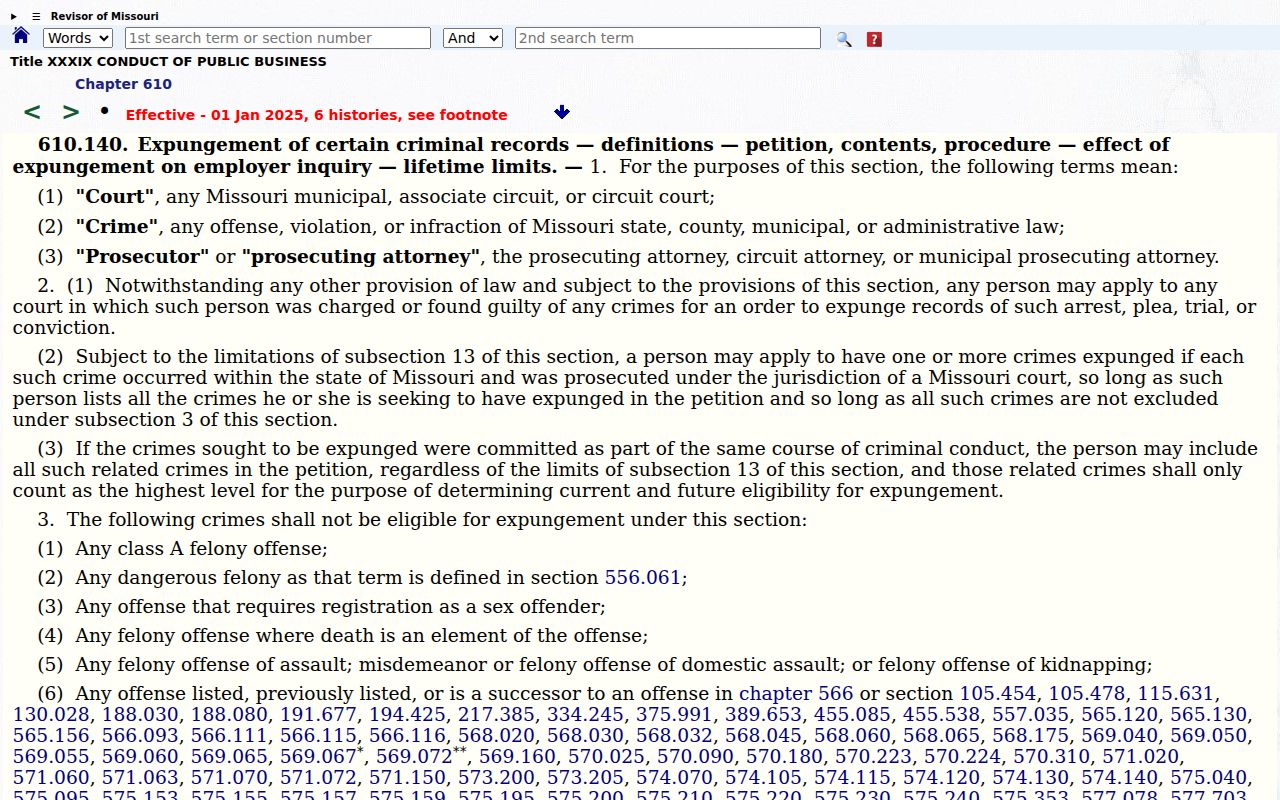
When a result is restricted, ask the court which statute, rule, or order controls, and whether a motion or authorized-access process is required.
The official juvenile-record confidentiality statute provides the second reference image. Reynolds Division III carries a juvenile assignment. Still, juvenile content does not surface through an ordinary criminal docket search.
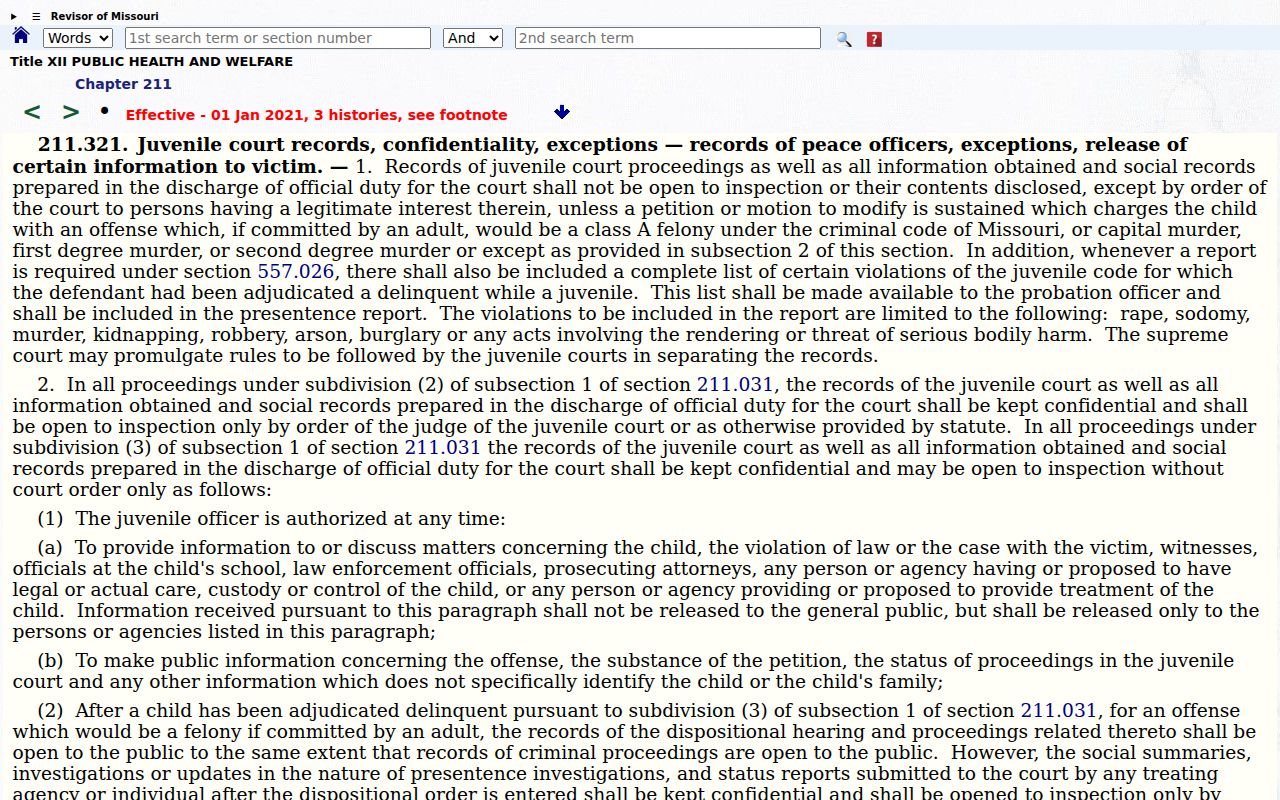
A juvenile, sealed, mental-health, search-warrant, or protected-victim restriction can cover a whole case or just one document. A visible case header does not make every attachment public.
Reynolds Criminal Records That Stay Closed
Not every dead end means a sealed Reynolds County file. Sometimes the cause is plain. A misspelled name, the wrong county, an old paper file, a citation number can all hide a docket entry. So can a municipal case moved elsewhere. Other gaps are deliberate. Juvenile proceedings, expunged records, some mental-health records, protected victim information, filing-information sheets, and certain search-warrant material all carry special restrictions. So an empty result online does not prove the court did nothing.
Use the exact case or citation number first if you have it. Still stuck? Call the Circuit Clerk. Ask whether the matter is public, restricted, sealed, expunged, filed under a different number, or sitting in another division. The clerk can walk you through the process. The clerk can point you to the right office. The clerk cannot decide expungement eligibility, though, or hand out legal advice. A focused Reynolds County docket search works well for basic case lookup too.